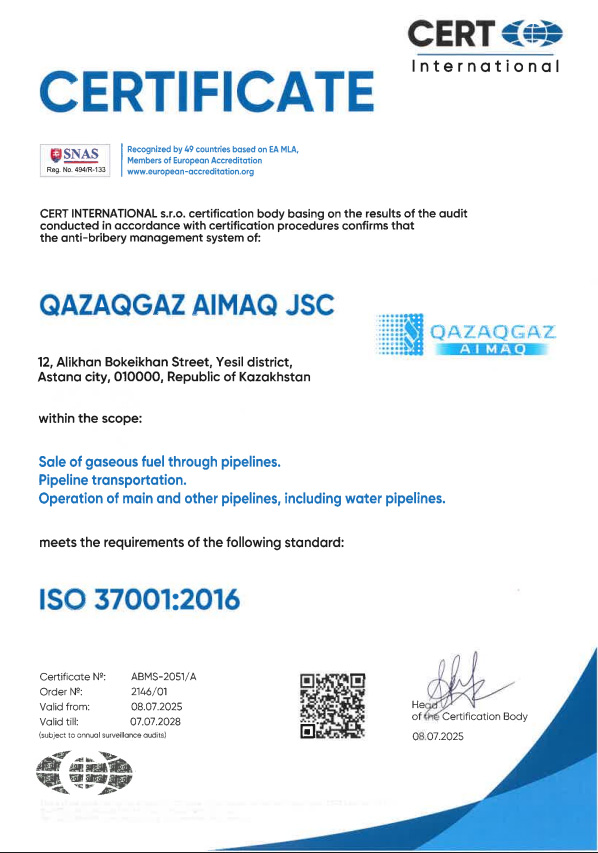
Integrated management system
As part of its commitment to sustainable development, JSC QazaqGaz Aimaq is consistently implementing and improving an Integrated Management System (IMS) that encompasses the key areas of its production and management activities.
The Company has implemented and certified management systems in accordance with international standards:
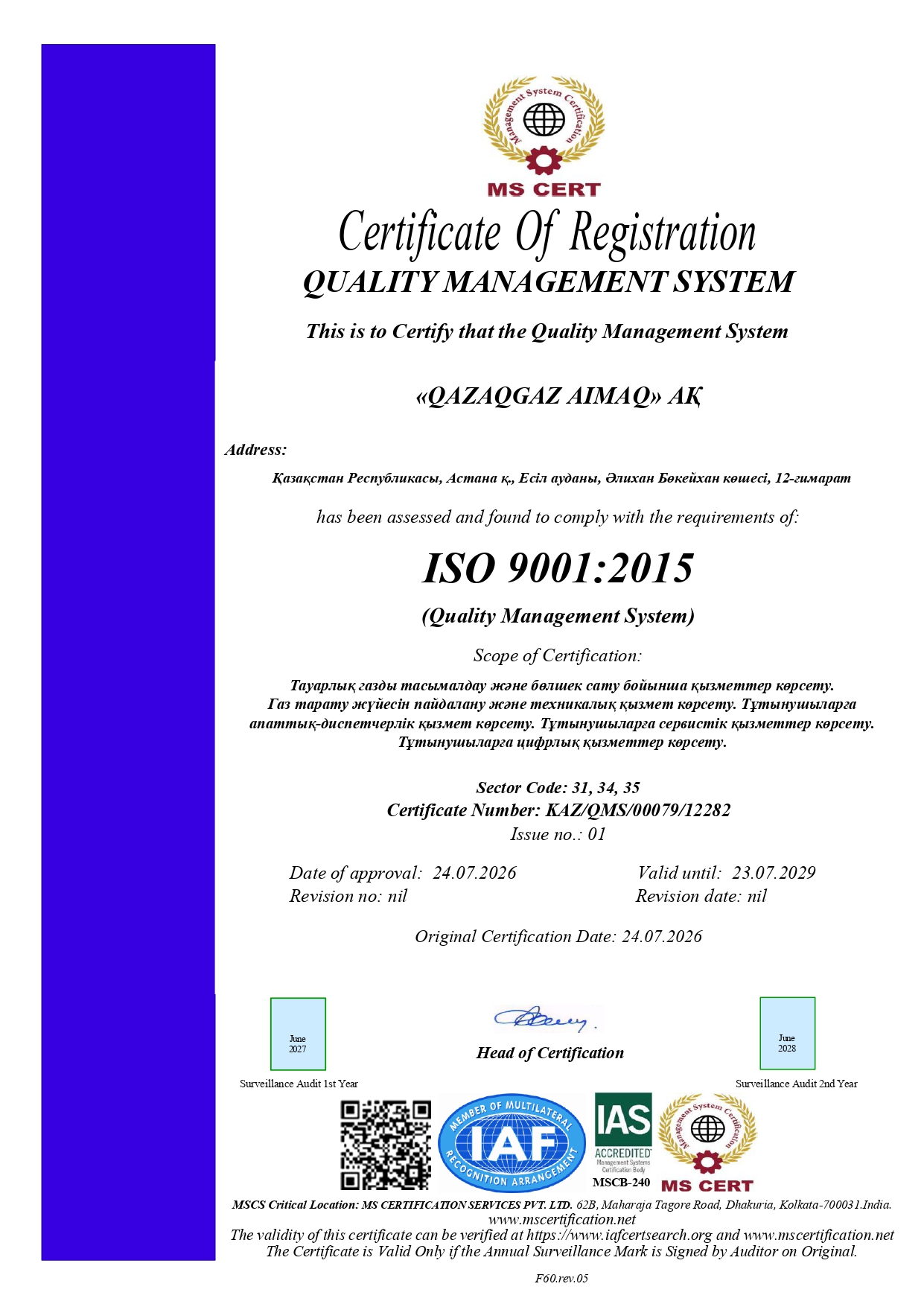
ISO 9001 – Quality Management System
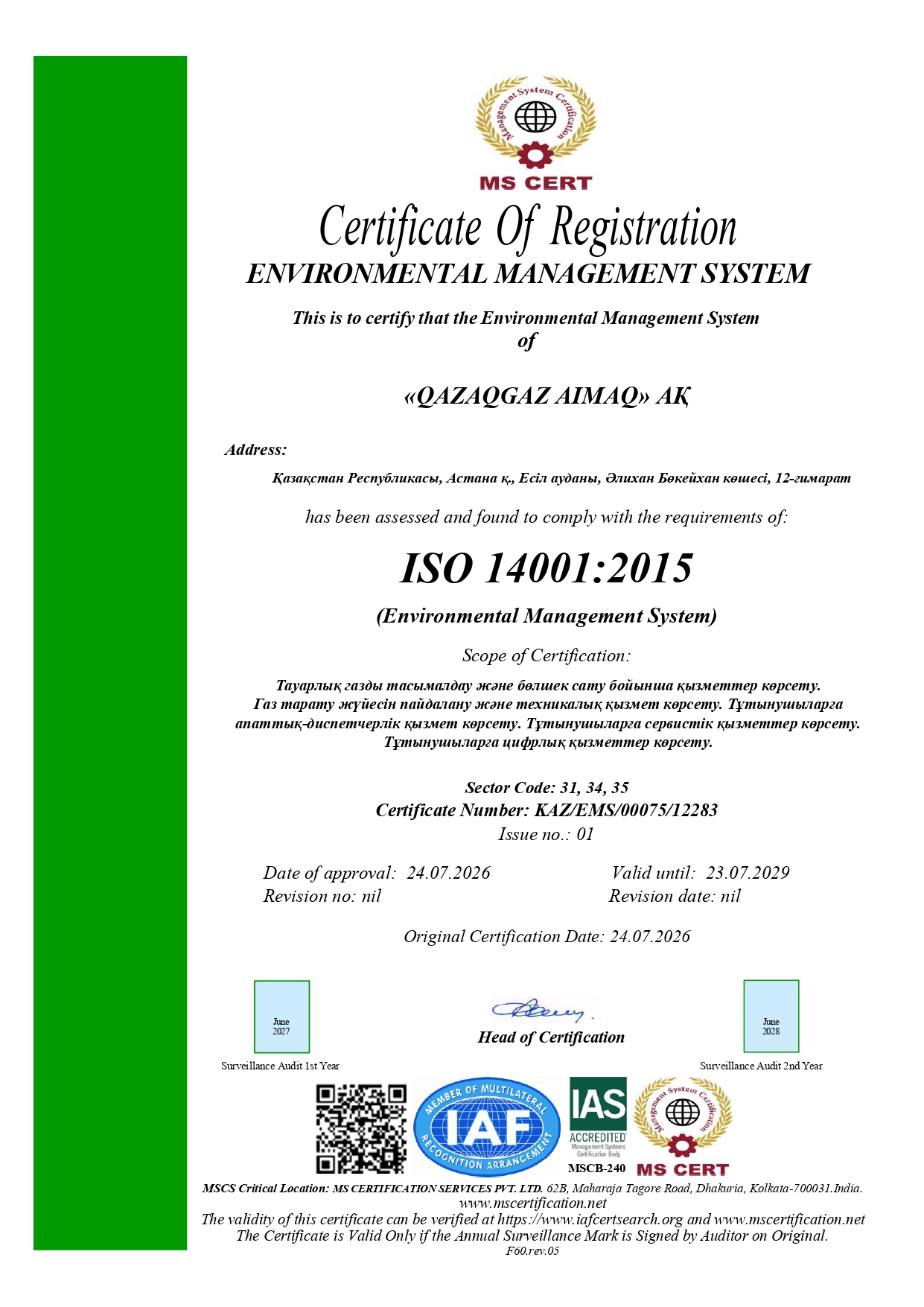
ISO 14001 – Environmental Management System
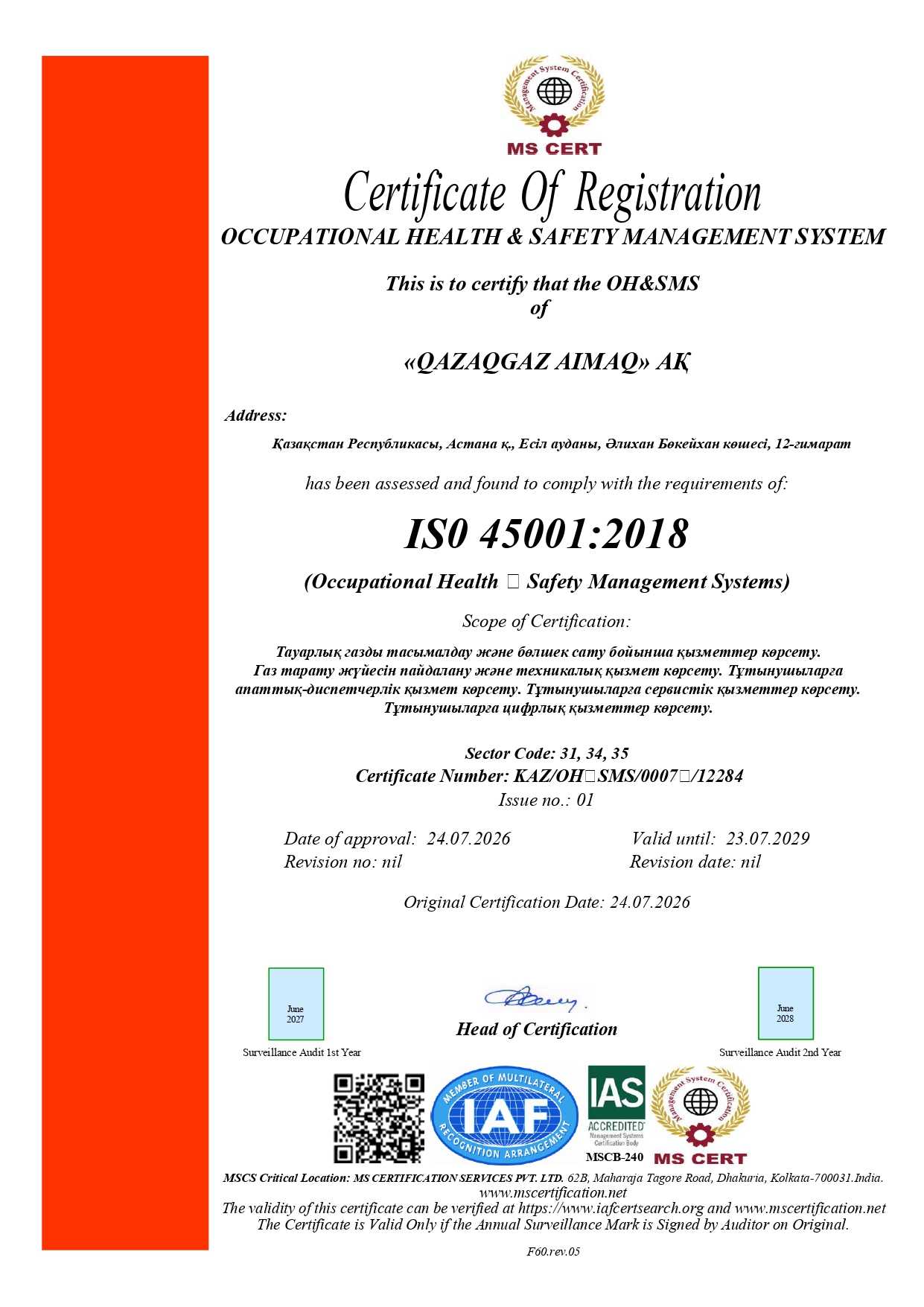
ISO 45001 – Occupational Health and Safety Management System
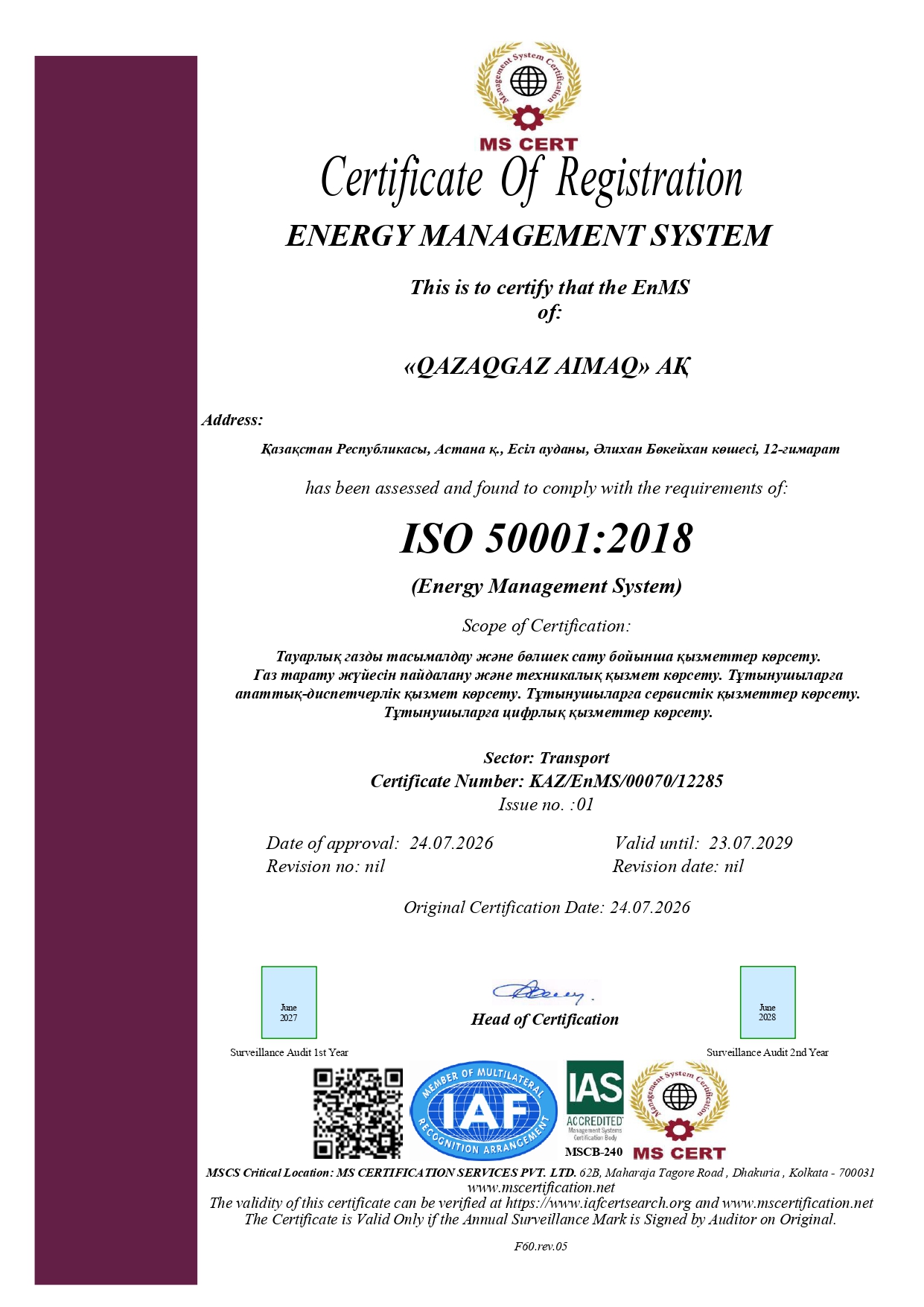
ISO 50001 – Energy Management System
ISO 37001 – Anti-Bribery Management System
The implemented IMS enables the Company to:
Ensure high-quality services in the field of gas supply
Minimize risks in occupational health and environmental protection
Use resources efficiently and reduce energy consumption
Foster an open and ethical business environment
The Company carries out systematic work on internal audits, risk assessments, staff competence development, and business process improvement.
The integrated management approach supports the achievement of strategic objectives and strengthens the trust of customers, partners, and the government.
The Quality Policy is aimed at:
Monitoring and controlling the Company’s activities related to commercial gas supply and the operation of production facilities, ensuring compliance with the legislation of the Republic of Kazakhstan, regulatory and technical requirements, national and international standards, as well as environmental and labor legislation;
Implementing sustainable development initiatives, including the introduction of modern technologies, modernization of gas distribution networks, facilities, and production equipment, process optimization, and enhancement of safety and production culture;
Reducing costs and increasing labor productivity in gas supply through the adoption of advanced approaches, modern technologies, and management systems;
Managing business activities as a system of interconnected processes;
Continuously improving the effectiveness and efficiency of the quality management system;
Ensuring effective communication between the Company’s structural divisions and employees, as well as with consumers, the public, authorities and regulatory bodies, business partners, and suppliers;
Enhancing the professional qualifications, competencies, and awareness of the Company’s personnel and its production branches;
Improving corporate culture in the areas of quality, health protection, environmental protection, energy efficiency, energy saving, and anti-corruption;
Motivating the Company’s personnel to carry out their work with an understanding of their personal responsibility for the quality of services provided, reducing environmental impact, minimizing health and occupational safety risks, and increasing energy efficiency;
Ensuring flawless execution of work under signed contracts and agreements;
Organizing effective quality management in all divisions of the Company;
Applying, when necessary, crisis management aimed at preventing or eliminating adverse factors affecting business processes, through the development and implementation of strategic programs that help maintain and strengthen market positions, primarily using internal resources.
To implement the Company’s Environmental Protection Policy and to manage the risks of environmental impacts, the Company adheres to the following principles:
Continuously improve the effectiveness and efficiency of the environmental management system in accordance with the requirements of the international standard ISO 14001, as applied to gas supply and service operations;
Take into account international environmental and natural resource management standards, best practices of leading companies in this field, as well as the latest scientific and technological advancements;
Ensure the preservation of the natural environment along gas pipelines, facilities, and other production and non-production assets;
Periodically identify and assess the Company’s compliance with international and national legislation, regulatory requirements, and other stakeholder requirements adopted by the Company;
Consider the views of all stakeholders in the functioning of the environmental management system, ensuring effective communication with consumers, the public, government and regulatory authorities, business partners, and suppliers;
Promote sustainable development through the rational use and conservation of natural resources, as well as the prevention of environmental pollution.
The Occupational Health and Safety Policy of QazaqGaz Aimaq JSC is aimed at monitoring and controlling the proper operation of the Company’s production facilities, as well as at the continuous reduction of risks and impacts of hazardous and harmful production factors on employees’ health and safety. The Policy also focuses on improving the efficiency of safe (accident-free) gas supply.
The Company undertakes the following commitments:
continuously improve the effectiveness and efficiency of the occupational health and safety management system in accordance with the requirements of the international standard ISO 45001, applicable to its domestic market operations;
ensure that the occupational health and safety management system complies with applicable legislation, regulatory legal acts, and the requirements of stakeholders;
ensure mutually beneficial cooperation and proactive information sharing on occupational health and safety matters with all stakeholders;
reduce occupational health and safety risks and prevent workplace injuries and employee health deterioration;
achieve high performance indicators in the field of occupational health and safety;
apply control methods and implement effective corrective and preventive actions.
The policy is aimed at:
Continuous implementation of energy-saving measures while maintaining a high level of service quality;
Achieving efficient use of energy resources;
Further development of energy-saving culture among Company employees;
Motivating personnel to use energy resources effectively.
The Company’s management declares its commitment to improving the energy efficiency of provided services, ensuring the rational use and conservation of energy resources, and protecting the environment through the continual improvement of the energy management system.
The Company undertakes the following commitments:
1) To continuously improve its energy performance through the implementation of organizational, economic, financial, technical, technological, and legal measures aimed at reducing energy consumption and introducing the latest environmentally safe and energy-efficient technologies across all areas of activity;
2) To ensure the availability of information and provision of necessary resources to achieve the established goals and objectives;
3) To comply with state, industry, and corporate standards, as well as legal and regulatory requirements in the field of energy management, energy efficiency, and energy conservation;
4) To manage the efficient use of energy resources based on regular assessments of significant energy users, monitoring, measurement, and analysis of key characteristics of the energy management system in gas supply and service delivery;
5) To continuously enhance personnel qualifications, raise awareness, and foster individual responsibility for the functioning of the energy management system, energy efficiency, and energy conservation;
6) To reduce the negative environmental impact associated with energy consumption;
7) To support the procurement of energy-efficient products and services and to develop projects aimed at improving the Company’s energy performance
The Corporate Risk Management Policy (hereinafter – CRMP) is aimed at ensuring reasonable assurance in achieving the following objectives:
Strategic objectives;
Operational objectives – efficient and effective use of resources, safeguarding of assets;
Reporting objectives – ensuring reliable and accurate reporting;
Compliance objectives – adherence to applicable laws and internal requirements.
Objectives of the CRMP and Internal Control System:
1) Enhancing risk culture and integrating risk management and internal control into all aspects of the Company’s activities;
2) Reducing volatility in performance by improving the Company’s ability to anticipate threats to its objectives, respond effectively to adverse events, and reduce their impact to an acceptable level;
3) Ensuring value creation by leveraging opportunities to increase asset value and profitability over the long term.
The Company is committed to continuously improving its risk management and internal control systems.
Risk Response Strategies
Risk response strategies are developed taking into account the operating environment, cost-benefit assessment, existing obligations, stakeholder expectations, risk prioritization, and the defined risk appetite.
The following risk response strategies are distinguished:
Risk acceptance – the risk level is deemed acceptable, and no mitigation measures are required;
Risk avoidance – refraining from activities that may lead to unacceptable risks;
Risk escalation – consciously taking on higher risks in pursuit of additional financial or other benefits;
Risk reduction – influencing the likelihood and/or impact of a risk (potential losses) through preventive measures and action planning;
Risk transfer (financing) – transferring or sharing risk with another party (e.g., through insurance or outsourcing).
Risk Management Structure and Information Flow
The risk management structure ensures adequate information flow both vertically and horizontally.
Bottom-up information provides the Board of Directors and the Management Board with data on operations, risk assessments, controls, response strategies, and risk governance performance.
Top-down communication conveys goals, strategies, the desired risk culture, risk appetite and tolerance through internal regulations and management directives.
Horizontal information exchange includes collaboration between structural units within the Company, as well as coordination between the risk management function and other risk-responsible units.
The Policy establishes:
1) The key principles of anti-corruption activities within the Company;
2) The managerial and organizational framework for preventing corruption-related offenses;
3) Measures aimed at minimizing and preventing corrupt actions;
4) The procedure for conducting compliance checks/investigations in case of violations;
5) The foundations for fostering employee commitment to strict compliance with the legislative acts of the Republic of Kazakhstan, as well as internal regulatory documents governing the Company’s activities;
6) General principles for giving and receiving gifts, providing and accepting hospitality within the Company, and the responsibilities of structural units in registering gifts and acts of hospitality.
The main purpose of this Policy is to ensure that the Company’s officers and employees adhere to high standards of conduct, conduct business in an open and honest manner, enhance the Company’s business reputation, and build trust in the Company.
This Policy is mandatory for review and strict compliance by all affiliated persons, officers, and employees of the Company (including outsourced personnel).
The Company also recommends that its counterparties follow the provisions of this Policy and its annexes and ensure that their employees comply with the Policy’s requirements.
If the legislation of the Republic of Kazakhstan establishes stricter requirements than those outlined in this Policy, the legislative requirements of the Republic of Kazakhstan shall prevail.